
Meaning
Original name of the city is unknown. In 1937 the researcher Alberto Escalona Ramos called it Oxtankah, a place name that can have three interpretations: “in the middle of three towns”, “three neighborhoods” or “place surrounded by Ramones”.
*The ramón is a tree (Brosium alicastrum) that blooms in summer.
Original name of the city is unknown. In 1937 the researcher Alberto Escalona Ramos called it Oxtankah, a place name that can have three interpretations: “in the middle of three towns”, “three neighborhoods” or “place surrounded by Ramones”.
*The ramón is a tree (Brosium alicastrum) that blooms in summer.
How to get there (from Mahahual)
Take note
Cultural importance
It is the largest and most important pre-Hispanic city that has been discovered in Chetumal Bay.
The first Mayan groups took up residence in Oxtankah around 600 BC. C., remaining there until 1100 AD. In that time period, three moments of high population density occurred: Late Preclassic (300-50 BC) Early classic (250-600 AD) and Late-terminal classic (600-900 AD).
It is the largest and most important pre-Hispanic city that has been discovered in Chetumal Bay.
The first Mayan groups took up residence in Oxtankah around 600 BC. C., remaining there until 1100 AD. In that time period, three moments of high population density occurred: Late Preclassic (300-50 BC) Early classic (250-600 AD) and Late-terminal classic (600-900 AD).
The maximum prosperity of its socio-political system was achieved during the Early Classic, when the leading groups of Oxtankah served as rulers of the surrounding towns, reflecting their power still in architecture. At that time several buildings were noticeably expanded, doubling their original proportions; The extension of the city exceeded the limits of the coast, incorporating Tamalcab Island.
The core area of the settlement comprised at least ten plazas and two sunken courtyards delimited by buildings, more than thirty isolated structures and a cenote. The dominant architectural design of the structures is of the Petén style: superimposed bodies with sloping walls, with rounded and tucked corners, whose essential element is the so-called molding “in apron”.
To supply themselves with fresh water, they built wells and chultunes, where they captured rainwater. Navigation was a common activity, so in canoes they traveled through the channels of the region and crossed the bay of Chetumal to transit the Caribbean Sea from north to south, interacting with other coastal populations and participating in long-distance exchange systems. to obtain foreign marine and terrestrial products that they distributed to other communities settled inland. At the entrance of the Spanish, Oxtankah had been abandoned for about 400 years.
The core area of the settlement comprised at least ten plazas and two sunken courtyards delimited by buildings, more than thirty isolated structures and a cenote. The dominant architectural design of the structures is of the Petén style: superimposed bodies with sloping walls, with rounded and tucked corners, whose essential element is the so-called molding “in apron”.
To supply themselves with fresh water, they built wells and chultunes, where they captured rainwater. Navigation was a common activity, so in canoes they traveled through the channels of the region and crossed the bay of Chetumal to transit the Caribbean Sea from north to south, interacting with other coastal populations and participating in long-distance exchange systems. to obtain foreign marine and terrestrial products that they distributed to other communities settled inland. At the entrance of the Spanish, Oxtankah had been abandoned for about 400 years.
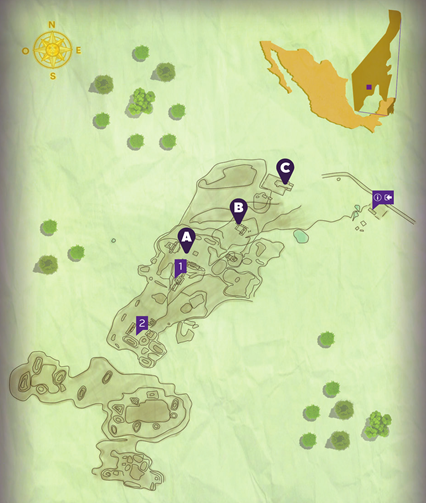
Plan
you can "click" on the plan to view it and download it in PDF
you can "click" on the plan to view it and download it in PDF


























www.MAHAnow.com

LANGUAGE


CLiCK to
back to
back to





Crafts


Bicycle
Archaeological Sites


Beach Club


Diving


Fishing


Four wheels
Hammock


Kayak


Massage






Paddle Board
Snorkel






® 2021 MAHAnow.com
All rights reserved
All rights reserved
All the information and images published in this section of the MAHAnow.com domain have been A from the Internet, Social Networks or through Google Maps. All public places and without restrictions. If you wish NOT to participate in the Project, please send a WhatsApp message to the number (818) 458-5996 requesting your cancellation and we will do so in less than 72 hours.
Information obtained from the National Institute of Antopology and History.
The box office is in charge of the INAH.
General Admission: no more than $65.00 mxpesos per person.
Schedule: Monday to Sunday - 09:00 to 15:00 hrs (3:00 p.m.)
*last access - 14:30 hrs (2:30 p.m.)
Recommendations:
Bring fresh clothing and comfortable shoes, water, mosquito repellent and sun protection, a cap or hat.
Services available in the area: Parking, information center and toilets.
Parking: The visitor must cover an additional fee for the use of the parking lot.
Respect the instructions of the INAH staff at the archaeological site.
The box office is in charge of the INAH.
General Admission: no more than $65.00 mxpesos per person.
Schedule: Monday to Sunday - 09:00 to 15:00 hrs (3:00 p.m.)
*last access - 14:30 hrs (2:30 p.m.)
Recommendations:
Bring fresh clothing and comfortable shoes, water, mosquito repellent and sun protection, a cap or hat.
Services available in the area: Parking, information center and toilets.
Parking: The visitor must cover an additional fee for the use of the parking lot.
Respect the instructions of the INAH staff at the archaeological site.
HOME
MAHAHUAL
#PerfectDay
Hire Directly Without Intermediarires

Tourist Directory


