

How to get there (from Mahahual)
Information obtained from the National Institute of Antopology and History.
The box office is in charge of the INAH.
General Admission: no more than $65.00 mxpesos per person.
Schedule: Monday to Sunday - 08:00 to 17:00 hrs (5:00 p.m.)
*last access - 16:30 hrs (4:30 p.m.)
Recommendations:
Bring fresh clothing and comfortable shoes, water, mosquito repellent and sun protection, a cap or hat.
Services available in the area: Parking, information center and toilets.
Parking: The visitor must cover an additional fee for the use of the parking lot.
Respect the instructions of the INAH staff at the archaeological site.
The box office is in charge of the INAH.
General Admission: no more than $65.00 mxpesos per person.
Schedule: Monday to Sunday - 08:00 to 17:00 hrs (5:00 p.m.)
*last access - 16:30 hrs (4:30 p.m.)
Recommendations:
Bring fresh clothing and comfortable shoes, water, mosquito repellent and sun protection, a cap or hat.
Services available in the area: Parking, information center and toilets.
Parking: The visitor must cover an additional fee for the use of the parking lot.
Respect the instructions of the INAH staff at the archaeological site.
Take note
You arrive at the site on Federal Highway #186 (Chetumal-Escárcega), until you reach the detour at Km. 215.5 that leads along a paved road to the towns of Morocoy and San Pedro Peralta.
Passing Morocoy, in the place known as “La Pista”, take the detour that leads to the site, 7 kilometers to the east, along a paved road that leads directly to the archaeological zone.
Passing Morocoy, in the place known as “La Pista”, take the detour that leads to the site, 7 kilometers to the east, along a paved road that leads directly to the archaeological zone.
Meaning
The original name of the settlement is unknown. Dzibanché is the name that Thomas Gann (English military doctor and amateur archaeologist) assigned to the site during his visit in 1927. It is a Mayan word that means “wooden writing” and refers to the carved wooden lintels located in the openings of the Temple of Building VI, which were removed to guarantee their conservation.
The original name of the settlement is unknown. Dzibanché is the name that Thomas Gann (English military doctor and amateur archaeologist) assigned to the site during his visit in 1927. It is a Mayan word that means “wooden writing” and refers to the carved wooden lintels located in the openings of the Temple of Building VI, which were removed to guarantee their conservation.
Cultural importance
The Dzibanché - Kinichná complex is located in a transition zone between the lowland jungle of the north of the Yucatan Peninsula and the tropical rainforest of Petén. The settlement occupies an area of more than 40 km2 and is made up of four groups of monumental architecture: Dzibanché or Main Group, Central Complex or Lamay Group, Tutil and Kinichná, groups that had specific functions, interconnected by sacbés or white Mayan roads.
In the architecture of the site it is possible to observe the Peten style, a style that was replaced in the middle of the Classic (approximately 600 AD), by temples with facades decorated with paired pilasters, very high double-developed vaults with tensioners at the ends of their narrow galleries and bases with bodies decorated with slope – board, characteristics belonging to a local style, associated with the Kaan dynasty, which was established on the site during the Early Classic. The existence of hieroglyphic texts engraved on the monuments on the stairs of the Temple of the Captives and finds of sumptuous offerings in funerary chambers, denote that Dzibanché was involved in the conquest of several towns, war conquests carried out by several rulers of the Kaan family, during more than two centuries. The Dzibanché occupation sequence has its beginnings in the late Preclassic (300 BC), and the settlement reached its population climax in the Classic (400-700), whose population
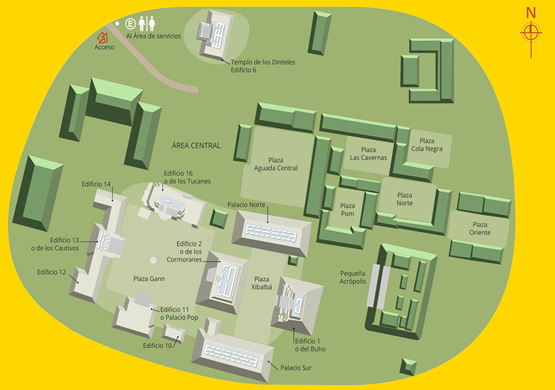
In the Main Group, the main buildings are Temples I (or Temple of the Owl) and Temple II (or Temple of the Cormorants), located in Plaza Xibalbá; and the Captive and Toucan Buildings, located in Plaza Gann.
The Dzibanché - Kinichná complex is located in a transition zone between the lowland jungle of the north of the Yucatan Peninsula and the tropical rainforest of Petén. The settlement occupies an area of more than 40 km2 and is made up of four groups of monumental architecture: Dzibanché or Main Group, Central Complex or Lamay Group, Tutil and Kinichná, groups that had specific functions, interconnected by sacbés or white Mayan roads.
In the architecture of the site it is possible to observe the Peten style, a style that was replaced in the middle of the Classic (approximately 600 AD), by temples with facades decorated with paired pilasters, very high double-developed vaults with tensioners at the ends of their narrow galleries and bases with bodies decorated with slope – board, characteristics belonging to a local style, associated with the Kaan dynasty, which was established on the site during the Early Classic. The existence of hieroglyphic texts engraved on the monuments on the stairs of the Temple of the Captives and finds of sumptuous offerings in funerary chambers, denote that Dzibanché was involved in the conquest of several towns, war conquests carried out by several rulers of the Kaan family, during more than two centuries. The Dzibanché occupation sequence has its beginnings in the late Preclassic (300 BC), and the settlement reached its population climax in the Classic (400-700), whose population
In the Main Group, the main buildings are Temples I (or Temple of the Owl) and Temple II (or Temple of the Cormorants), located in Plaza Xibalbá; and the Captive and Toucan Buildings, located in Plaza Gann.
Plan
you can "click" on the plan to view it and download it in PDF
you can "click" on the plan to view it and download it in PDF



Crafts


Bicycle
Archaeological Sites


Beach Club


Diving


Fishing


Four wheels
Hammock


Kayak


Massage






Paddle Board
Snorkel



























www.MAHAnow.com

LANGUAGE


CLiCK to
back to
back to



® 2021 MAHAnow.com
All rights reserved
All rights reserved
All the information and images published in this section of the MAHAnow.com domain have been A from the Internet, Social Networks or through Google Maps. All public places and without restrictions. If you wish NOT to participate in the Project, please send a WhatsApp message to the number (818) 458-5996 requesting your cancellation and we will do so in less than 72 hours.
HOME
MAHAHUAL
#PerfectDay
Hire Directly Without Intermediarires

Tourist Directory


